















 Idman.biz
For Azerbaijan, the Turkish national team's qualification for the 2026 World Cup is, as is known, not perceived as an alien success. The fraternal relations between the two countries have long gone beyond the framework of politics and diplomacy, and therefore the return of the Turkish national team to the World Cup after 24 years also creates special emotions among Azerbaijani fans who are looking for a team to support at the upcoming 2026 World Cup.
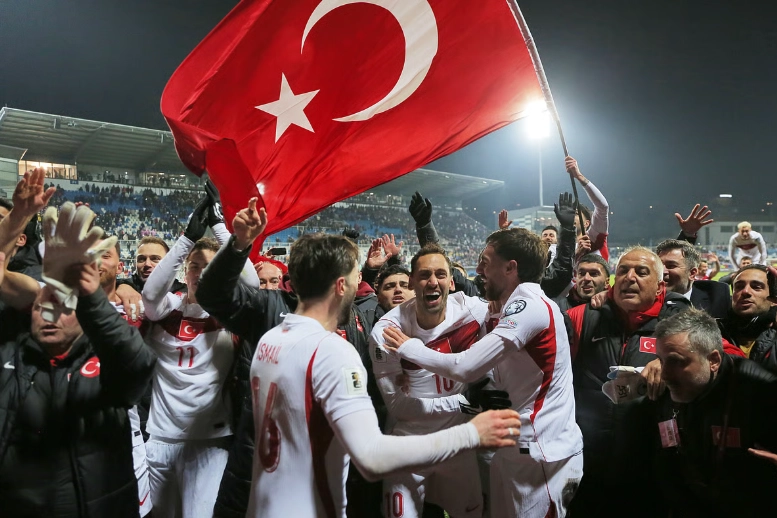
Idman.Biz reports that a 1-0 victory over the Kosovo national team in the play-off final gave Turkey a ticket to the World Cup finals for only the third time in its history. Previously, the Turks participated in the world championships only in 1954 and 2002.
The current qualification immediately turned into a big national holiday. After the final whistle, the streets of Turkish cities were filled with flag-waving fans, cars honked everywhere, and the festive atmosphere quickly crossed the country's borders. The team's return to the planet's biggest football tournament after a long break was celebrated en masse, and even the Turkish diaspora living in Berlin organized a magnificent celebration.
Against this background, it is interesting to recall that the history of Turkey's performance at the World Championships was previously formed in an unusual way. The first ticket to the 1954 World Cup was won with one of the strangest scenarios of the qualifying stage. In that qualifying group, the Turks only faced the Spanish national team. Initially, the South Korean national team was also in the group, but later FIFA moved it to the Asian zone, and as a result, only two teams remained in the group.
The oddities did not end there. The first game in Madrid ended with Turkey losing 1:4, while in Istanbul the home team took revenge by winning 1:0.
Since there was no away goal rule at that time, an additional game was scheduled on neutral ground in Rome, and this match ended in a 2:2 draw after extra time. There was no penalty shootout in those years either, so the winner was determined by a draw. The son of a stadium employee, 14-year-old Luisi Franco Gemma, drew Turkey's name, and this is how the team qualified for the World Cup for the first time in its history.
Paradoxes continued for Turkey in the tournament held in Switzerland. Its rivals in the group were the Hungarian national team, the German national team and South Korea. It is interesting that although the Turks played with the Germans twice, they did not face the Hungarians, who later reached the final together with Germany, at all.
The 1954 World Cup was held with unusual regulations: there were two seeded and two unseeded teams in each group, and they faced each other not in a round-robin system, but only with rivals from the other basket. Therefore, Turkey, as a seeded team, played not with Hungary, but with unseeded South Korea and Germany.
The first game with Germany ended with a 1:4 defeat, then Turkey defeated South Korea 7:0, but lost again to Germany in an additional game for qualifying from the group - this time 2:7. Thus, an almost unique situation arose: although the Turks were in the same group with two future finalists, they did not play with one of them at all.
Turkey's second appearance at the World Cup turned into a real football fairy tale. At the 2002 World Cup, Şenol Güneş's team advanced to the semi-finals and eventually won a bronze medal, which is still the best result in the history of the national team. It was in that tournament that one of the most famous records of the World Championships was recorded: in the match for third place, Hakan Şükür scored against South Korea already in the 10.8th second, and this remains the fastest goal in the history of the tournament.
Currently, Turkey is returning to the World Cup in a completely different status. For the older generation, this is an opportunity to relive the emotions of 2002, while for young fans it will be the first World Cup in which their national team participates. And perhaps the main feature of Turkey in the World Championships is precisely this: it rarely gets there, but almost always leaves its mark on history.